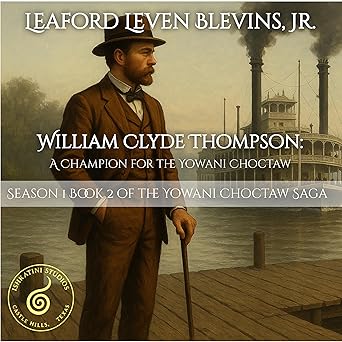
Early Life & Rescue
Around 1840, both parents of the infant William Clyde Thompson died near Fort Towson. His grandmother, Margaret McCoy, took responsibility for his care, with her brother James McCoy acting as a father figure. Oral tradition and family record describe a journey that Margaret, her husband, and James made to Fort Towson (often called Fort Thiessen in older references) to claim and raise the orphaned child. This moment defined Margaret’s role as the matriarch of the Yowani line — stepping in to preserve continuity of family and clan. William grew up effectively as her son.
Civil War Service
As a young man, William Clyde Thompson enlisted with the 6th Mississippi Infantry. He fought in some of the bloodiest campaigns of the western theater:
- Battle of Shiloh (1862)
- Siege of Vicksburg (1863)
- Battle of Franklin (1864)
In each, he survived while many around him perished. Records show he was wounded but returned to service — a mark of endurance and commitment. Though the Confederacy lost the war, William’s personal record was one of persistence against impossible odds.
Postwar Struggle
After 1865, William Clyde turned his focus to the fight for recognition and citizenship in the Choctaw Nation. He carried the Yowani claim forward for decades, appearing repeatedly before commissions and tribal councils. His persistence is notable:
- In 1909, the Choctaw Nation formally reinstated the Yowani as citizens, due in no small part to his advocacy.
- Yet, despite reinstatement, the federal bureaucracy denied the Yowani allotments of land — a final injustice in a chain of removals, exclusions, and punishments that reached back to Texas.
Legacy
Though William Clyde never gained allotments for his family, his relentless pursuit ensured that their identity as Choctaws was preserved in the record. For many descendants, including your own line, his survival in battle and persistence in law left a lasting inheritance. It is largely because of his work that later generations