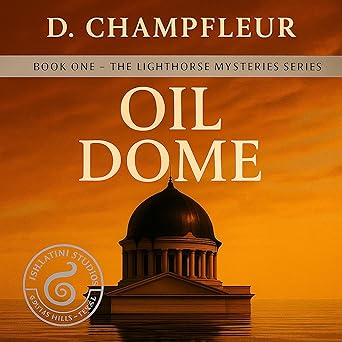
In the rolling countryside of eastern Oklahoma, where small towns sit quietly on land shaped by centuries of Chickasaw history, a single discovery shatters the calm. A young engineer with specialized knowledge of a hidden oil formation beneath the long-abandoned General Motors plant east of Oklahoma City turns up dead—his body placed on Chickasaw land, far from where his work should have taken him. The moment Captain Hawk of the Chickasaw Lighthorse Police hears the call, he senses that this will not be a simple investigation. Nothing about a murder placed deliberately on tribal land ever is.
Captain Hawk has spent his life navigating the responsibilities of tribal sovereignty. He knows the land, the people, and the long story of how the Chickasaw Nation came to govern these acres again after generations of struggle. What he does not yet know is why this young man, barely at the beginning of a promising career, was killed for what he knew—or how deeply his death is tied to the shifting legal landscape created by the recent U.S. Supreme Court decision that reaffirmed much of eastern Oklahoma as reservation land. That ruling, though historic, has unleashed a maze of jurisdictional complications for investigators across the state. It is into this maze that Hawk now steps.
Assigned to work at his side is Officer Overton, a young Lighthorse deputy eager to learn the true craft of investigative work. She admires Hawk’s steadiness, his judgment, and the quiet dignity with which he carries his responsibilities to his people. Though inexperienced, she quickly proves herself perceptive and capable. She asks the right questions, sees details others miss, and brings an emotional intelligence that helps her understand not only evidence, but the deeper human tensions at play in this strange death. For Overton, the case becomes her first real test—an introduction to the intricate world of major crimes that unfold on tribal land.
No sooner do Hawk and Overton begin their inquiry than the Oklahoma State Bureau of Investigation arrives in the form of Jack Holloway. Holloway is one of the most seasoned detectives in the state, long accustomed to walking the tightrope between tribal, state, and federal authority. He has worked enough cases to know that jurisdiction can drive an investigation as much as motive. Respectful but direct, Holloway brings with him a deep understanding of the legal and political complexities that now define eastern Oklahoma. He recognizes immediately that the young engineer’s murder could set off conflicts between agencies, corporations, and tribal governments if not handled with care.
With him is Betty Penny, a newly assigned OSBI detective whose specialty is financial crime. Penny brings a different kind of insight—one rooted in patterns, transactions, and the quiet trails left by people who believe money can hide anything. Her analytic mind cuts cleanly through speculation, and it is her instincts that first suggest the deeper implications of an oil discovery beneath abandoned industrial property. If someone wanted control of this engineer’s knowledge, or wanted it silenced, that motive could reach far beyond a single individual.
As the four investigators dig deeper, they uncover layers of possibility. Was the young man killed because he discovered something worth millions—or because he learned something about those who sought to control it? Why was his body placed on Chickasaw land rather than left at the plant? Was someone trying to manipulate jurisdiction, shift blame, or buy time before the truth came out?
Their search takes them through towns that lie quietly within the historic boundaries of the Chickasaw Nation—places where the past is always present, and where today’s law enforcement officers carry both modern responsibilities and ancestral memory. Each new lead exposes more of the intertwining threads of tribal authority, corporate ambition, unresolved history, and the fragile partnerships among law enforcement agencies.
As the case unfolds, the four investigators—Hawk, Overton, Holloway, and Penny—form an unexpected but powerful alliance. Their combined skills reveal a picture far more complex than anyone first imagined, pulling them toward a conclusion that tests loyalties, assumptions, and the boundaries of law.
Oil Dome is not just a mystery—it is a story about sovereignty, identity, and the new realities of law enforcement in a place where history and modern justice collide. It introduces the core team whose relationships and abilities will carry the Lighthorse Mysteries forward, and it draws readers into an Oklahoma rarely depicted with such authenticity, depth, and respect.